I Ate More and Lost 14 Pounds at 47. My Doctor Asked What I Did.
After years of calorie counting, brutal workouts, and watching the scale go up anyway, one woman stumbled on the hormone research that changed everything.
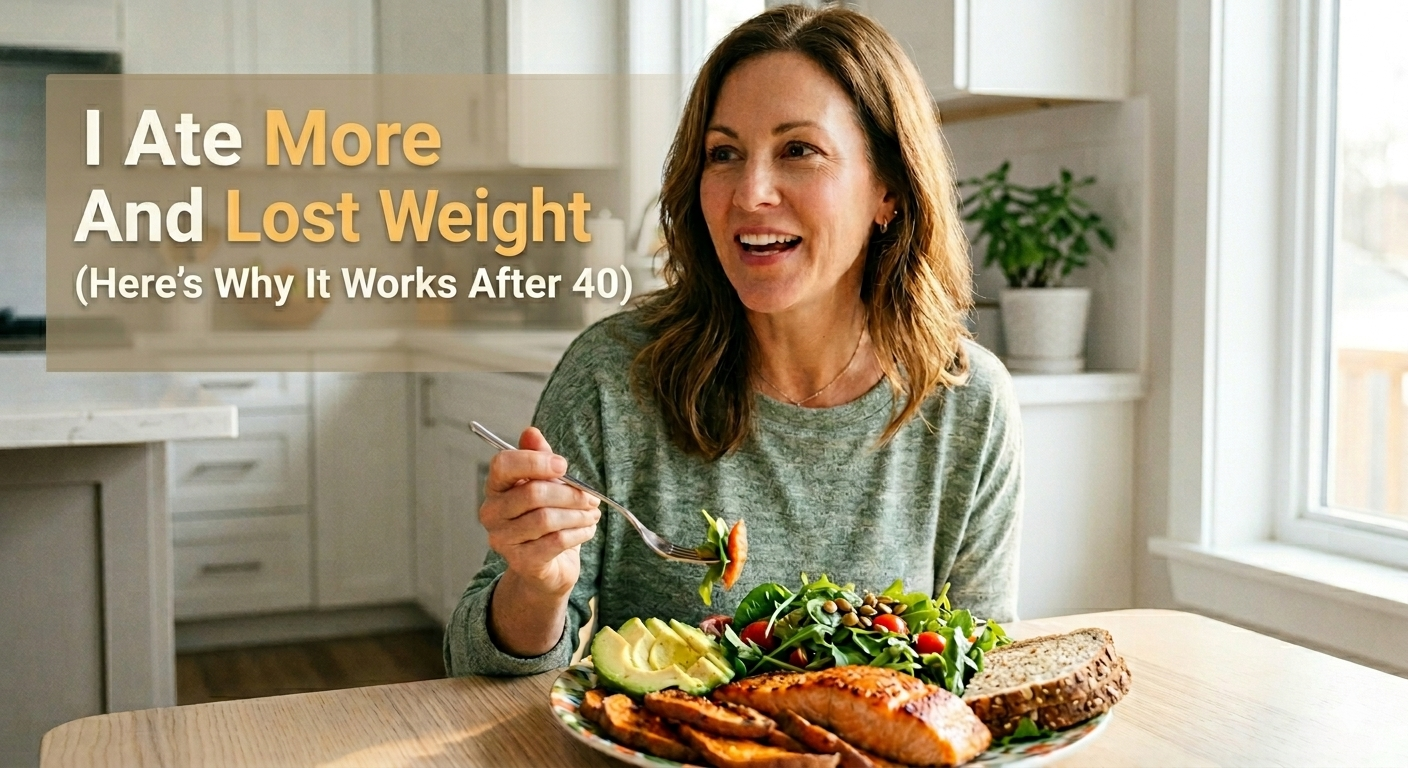
I want to tell you about the worst day of my diet career.
It was a Tuesday. I was 44. I'd been eating 1,200 calories a day for three months straight. Chicken breast, steamed broccoli, brown rice. I was exercising five days a week — two spin classes, three days of circuit training. I was tired all the time. I was starving all the time. And I was doing everything right.
I stepped on the scale that morning and I'd gained two pounds.
Two pounds. After three months of discipline that bordered on punishment.
I sat on the bathroom floor and cried. Not because of the number. Because I'd run out of ideas. If eating less and exercising more didn't work, what was left?
The Doctor Visit That Changed Nothing
I went to my doctor the following week. She ran bloodwork. Everything came back "within normal range." She told me to watch my portions, maybe try cutting carbs, and consider that weight gain is "just part of aging."
Just part of aging.
I nodded, drove home, and opened my laptop. If the medical system was going to give me a shrug, I'd figure it out myself.
That Google search changed everything. Not the first result, or the tenth. But somewhere around the 73rd research paper — a study from the Journal of Clinical Endocrinology — I found a sentence that stopped me cold:
Translation: eating less was literally telling my body to store belly fat.
Not because I was doing it wrong. Because after 40, the rules change. And nobody had told me.
The Three Hormones Nobody Talks About
I spent the next two years going down the rabbit hole. I read everything I could find from Harvard's menopause research group, the Endocrine Society, and dozens of clinical trials. And I found a pattern that every woman over 40 needs to understand:
- 1 Cortisol rises when you eat less. Your body reads calorie restriction as famine. It floods cortisol into your system, and cortisol's #1 job is storing fat around your organs — your belly. The harder you diet, the more cortisol, the more belly fat. You're dieting yourself fatter.
- 2 Estrogen drops and redirects fat storage. Before perimenopause, estrogen tells your body to store fat on your hips and thighs. As estrogen drops, that signal moves to your midsection. This isn't about eating too much. It's about a hormonal GPS that just changed the destination.
- 3 Insulin becomes resistant to your old patterns. The breakfast that fueled you at 35 now spikes your blood sugar at 45. Not because the food changed. Because your insulin response changed. Eat the wrong thing at the wrong time and your body stores it as fat instead of burning it.
Imagine what it would feel like to wake up without the 2 AM cortisol spike. To eat a full breakfast — eggs, avocado, real food — and watch your waist shrink instead of grow. To have energy at 3 PM without reaching for caffeine. To step on the scale and see it go down for the first time in years, while eating more than you have in months. That's not a fantasy. That's what happens when these three hormones are working together instead of against you.
Here's the part that wrecked me: all three of these hormones interact. Cortisol makes insulin resistance worse. Insulin resistance disrupts estrogen clearance. And estrogen imbalance raises cortisol. It's a loop. And every piece of standard diet advice — eat less, do more cardio, cut calories — makes the loop spin faster.
And the popular alternatives? They're worse. Keto after 40 spikes cortisol because your body reads extreme carb restriction as a stressor — the exact thing driving belly fat in the first place. Intermittent fasting tanks estrogen in perimenopausal women, accelerating the hormonal chaos. Appetite suppressants and "metabolism boosters" ignore the root cause entirely — they mask symptoms while the loop keeps spinning underneath. Even programs designed for women often miss this, because they're built on the same calories-in-calories-out model that stops working after 40.
So I Did the Opposite
I stopped cutting calories. I went from 1,200 to 1,600 calories a day.
I quit my spin classes. Replaced them with 20-minute resistance sessions, three times a week.
And I restructured when I ate — based on something I started calling the Cortisol Reset Window.
Here's the idea: every morning, your cortisol peaks naturally between 6 and 9 AM. What you eat during that window — and how much protein you front-load — determines whether your body spends the rest of the day burning fat or hoarding it. Every diet I'd ever tried either skipped this window entirely (intermittent fasting) or filled it with the wrong fuel (toast and coffee).
I built my entire day around it. Protein-heavy breakfast by 8 AM, during the peak of the cortisol window. Largest meal at lunch, when insulin sensitivity is highest. Lighter dinner by 7 PM, before the evening cortisol dip signals your body to start winding down. I called the full approach the Hormone Rebalance Method — three meals, timed to the three hormones, in the order your body actually needs them.
The first week, nothing dramatic happened. I just felt less tired.
The second week, my 2 AM wake-ups stopped. For the first time in three years, I slept through the night.
By week four, I'd lost 6 pounds. Eating more food than I had in months.
By week eight, I'd lost 14 pounds total. My wedding ring was loose. The bloating was gone. My afternoon brain fog had disappeared. And my doctor — the same one who'd told me to "watch my portions" — asked me what I'd changed.
It Wasn't Just Me
I started sharing what I'd learned with friends. Then with their friends. Then I couldn't keep up with the messages.
"I read Chapter 2 and literally cried. I finally understood why 12 years of dieting made things worse. This should be required reading for every woman who turns 40."
Rachel, 47, was eating 1,100 calories and exercising six days a week. She was exhausted and gaining weight. After switching to hormone-timed eating — more food, less exercise — she lost 8.4 pounds in 14 days.
Dawn, 53, had been doing Orange Theory four times a week for two years. Gaining weight the entire time. She dropped her sessions to three 20-minute resistance workouts per week and lost 4.2 inches from her waist in three weeks.
Maria, 51, thought it was just aging. Keto, intermittent fasting, 1,200 calories — nothing worked. She made one change from the estrogen chapter and her bloating disappeared in four days. She slept through the night for the first time in three years.
The pattern was always the same: women who'd tried everything, who were exhausted and frustrated, who thought their bodies were broken. Their bodies weren't broken. Their advice was.
I eventually wrote everything down. All the research, the hormone science, the meal timing framework, the sleep and movement protocols — everything I'd learned across 73 studies and two years of testing. It became a book called Eat More, Lose More. Seven chapters. No fluff. Every page written for women over 40.
The Part That Surprises Everyone
When I tell women the answer is eating more, they don't believe me. I get it. It sounds like a gimmick. We've been told our entire lives that weight loss equals eating less.
But that equation breaks down after 40. Here's what actually happens when you eat more of the right foods at the right times:
Cortisol drops. Your body stops thinking it's in a famine. It stops storing emergency fat around your belly.
Insulin stabilizes. When you eat protein first and time your carbs to your insulin curve, your blood sugar stops spiking and crashing. The 3 PM energy crash disappears. The sugar cravings quiet down.
Your body starts burning instead of storing. Not because you're eating less fuel. Because your hormones are finally getting the signal that it's safe to let go of the fat.
"The gut-hormone chapter alone was worth 10x the price. I made one change from page 94 and my bloating disappeared in four days. Four days."
What I Wish Someone Had Told Me at 40
I wasted three years. Three years of starvation diets, brutal workouts, and stepping on a scale every morning wondering what was wrong with me.
Nothing was wrong with me. My hormones had changed, and nobody told me the rules had changed with them.
If you're a woman over 40 and you're eating less, exercising more, and watching the scale go up anyway — it's not your fault. It's not your willpower. And it's not "just aging."
It's a hormonal pattern. It has a name. And it's fixable.
7 chapters covering the Cortisol Reset Window, the estrogen-timing framework, the insulin curve protocol, and the complete meal-by-meal system. Instant PDF download.
Get the Hormone Rebalance Method — $7 Instant download · 30-day money-back guarantee200+ women downloaded this week · 4.9 stars
"I lost 8.4 pounds in 14 days eating more food." — Rachel, 47
🔒 Secure checkout · Based on 73 peer-reviewed studies
I'm not going to tell you this book will make you lose 14 pounds in 8 weeks like I did. Every body is different. Every hormonal pattern is different.
But I will tell you this: if you finish Chapter 2 and don't have at least one moment where everything suddenly makes sense — where you finally understand why nothing has been working — you can email me and get every penny back. No questions.
It's $7. Less than the sad salad you ate for lunch yesterday while telling yourself this time would be different.
This time can actually be different. But not by eating less.
The complete Hormone Rebalance Method — the Cortisol Reset Window, the estrogen-timing framework, the insulin curve protocol. 7 chapters. Instant PDF download. Read Chapter 2 tonight.
Download the Hormone Rebalance Method — $7 30-day money-back guarantee · No questions asked200+ women downloaded this week · 4.9 stars
"My bloating disappeared in four days. I slept through the night for the first time in three years." — Maria, 51
🔒 Secure checkout · Based on 73 peer-reviewed studies