She Tracked Every Calorie for a Year and Gained 11 Pounds
Jenny Cheryl logged every meal, every snack, every bite for 365 days straight. She was in a deficit the entire time. And she gained 11 pounds anyway.
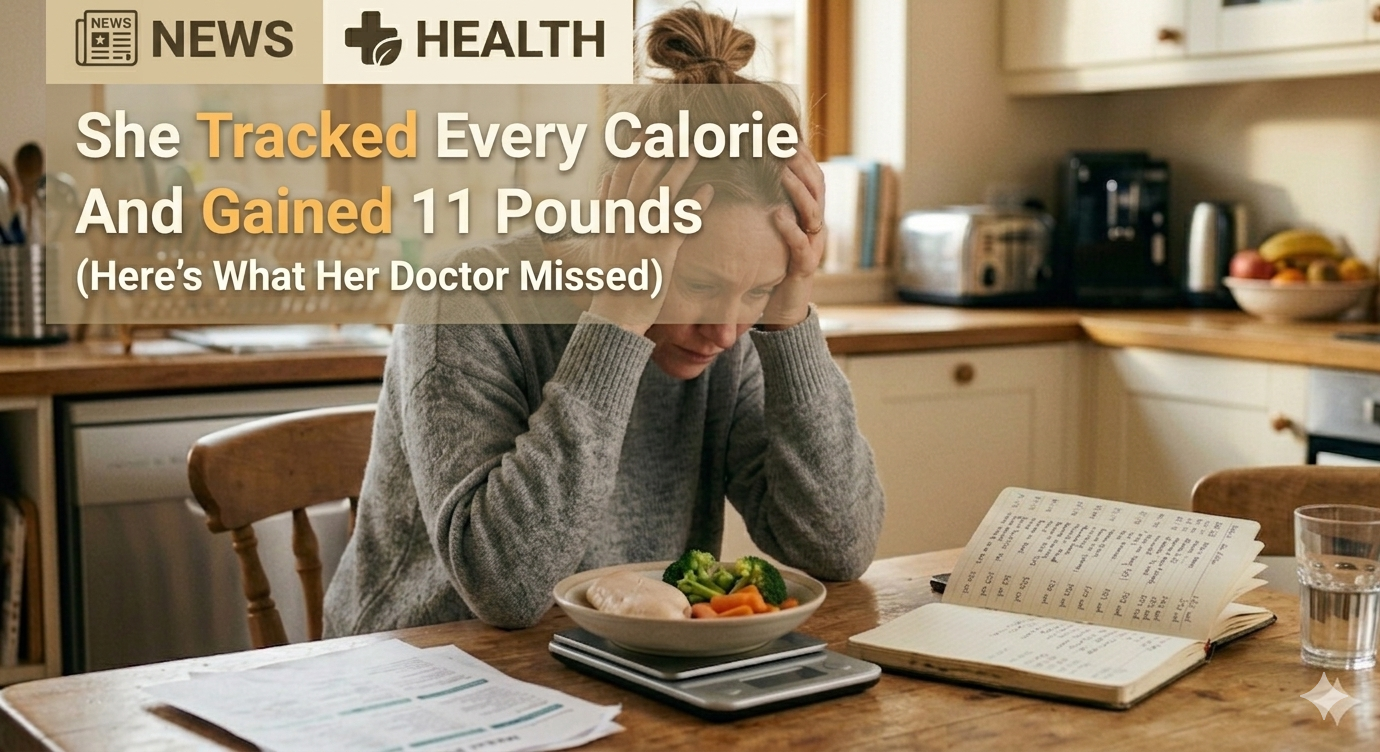
Jenny Cheryl has a spreadsheet on her laptop with 365 rows. One for every day of last year. Each row contains her total calorie intake, macros broken down to the gram, and a running weekly average. The numbers are meticulous. She weighed her chicken breast on a food scale. She measured her olive oil with a tablespoon, not a pour. She logged the creamer in her coffee — yes, even the half-and-half.
1,200 calories a day. Sometimes 1,150. Never more than 1,250. For an entire year.
She gained 11 pounds.
It's worth sitting with that for a second, because when Jenny tells people this, they don't believe her. They think she was sneaking snacks. They think she wasn't counting correctly. Her own doctor — a woman she'd trusted for a decade — looked at her over her reading glasses and said, "You're probably eating more than you think."
She wasn't. She has the spreadsheet. She has the food scale. She has the 365 days of MyFitnessPal logs to prove it.
The Year Her Body Turned Against Her
It started when Jenny turned 43. She'd gained about 8 pounds over the previous two years — slowly, almost imperceptibly — and she decided to get serious. She'd always been able to lose weight by cutting calories. It had worked in her 20s. It had worked in her 30s. So she did what she'd always done, just more strictly.
By month three, the scale hadn't budged. Not a single pound. She cut harder — dropped from 1,400 to 1,200. She added morning walks. She stopped eating out entirely. She skipped birthday cake at her own daughter's party.
But the weight wasn't the worst part. By month eight, her hair started falling out. Not dramatically — no bald spots — but she was pulling clumps from her brush every morning. Her nails became brittle and ridged. She was cold all the time, even in July. Her period, which had been irregular, stopped entirely for three months.
And the brain fog. The brain fog was relentless. Jenny is a project manager. Her job requires her to hold fifteen things in her head at once. She was forgetting meetings. Losing words mid-sentence. Staring at her computer screen unable to process what she was reading.
She went back to her doctor. The doctor ran a thyroid panel. Normal. She suggested antidepressants. Jenny wasn't depressed — she was starving.
What 1,200 Calories Actually Does to a Woman Over 40
Jenny found the answer at 1 AM on a Tuesday, reading a research paper about metabolic adaptation in perimenopausal women. What she learned made her furious — not at her body, but at every diet that had ever told her to eat less.
Here's what happens when a woman over 40 severely restricts calories:
- 1 Cortisol skyrockets. Your body interprets calorie restriction as a famine. It floods your system with cortisol, which tells your body to store fat — especially around the midsection — as a survival mechanism.
- 2 Thyroid downregulates. Your T3 (active thyroid hormone) drops, slowing your metabolism by up to 23%. Your body becomes ruthlessly efficient, burning fewer calories doing the exact same activities.
- 3 Muscle wastes away. Without adequate protein and calories, your body cannibalizes lean muscle for energy. Less muscle means an even slower metabolism. A vicious cycle.
- 4 Every calorie gets stored. Your body becomes hyper-efficient at converting food to fat. The same 1,200 calories that would have maintained your weight before now causes gain — because your metabolism has adapted to survive on less.
The research was clear: the harder Jenny restricted, the more her body fought back. She wasn't failing at her diet. Her diet was failing her. It was designed for a hormonal profile she no longer had.
"I was eating 1,100 calories a day and doing an hour of cardio six days a week. I gained 14 pounds in eight months. My trainer told me I needed more discipline. What I actually needed was more food."
Perimenopause · Former calorie restriction for 2 years
What Most Women Try Next — and Why It Makes Things Worse
Jenny tried everything before she found the answer. Keto lasted six weeks — her cortisol spiked so hard she started waking up at 2 AM drenched in sweat. Her body read extreme carb restriction as yet another stressor, flooding even more cortisol into a system that was already drowning in it.
Intermittent fasting killed her energy by 11 AM and her estrogen levels cratered. Extending the overnight fast during perimenopause accelerates the exact hormonal chaos that's driving the weight gain in the first place.
The metabolism-boosting supplement from Instagram gave her heart palpitations and did nothing for the scale. Appetite suppressants mask hunger signals while the hormonal loop keeps spinning underneath. They don't fix cortisol. They don't fix insulin. They don't fix estrogen.
Jenny didn't need another restriction. She needed the opposite.
The Terrifying Leap: Eating More
Everything Jenny read pointed to the same conclusion — she needed to eat more, not less. The concept is called working with your hormonal patterns rather than against them. But after a year of white-knuckling 1,200 calories, the idea of eating 1,600-1,800 felt like jumping off a cliff.
The key was something she started calling the Cortisol Reset Window. Every morning, your cortisol peaks naturally between 6 and 9 AM. What you eat during that window — and how much protein you front-load — determines whether your body spends the rest of the day burning fat or hoarding it. Every diet Jenny had tried either skipped this window entirely (intermittent fasting) or filled it with the wrong fuel (toast and coffee).
She built her entire day around it. Protein-heavy breakfast by 8 AM, during the peak of the cortisol window. Largest meal at lunch, when insulin sensitivity is highest. Lighter dinner by 7 PM, before the evening cortisol dip. She called the full approach the Hormone Rebalance Method — three meals, timed to the three hormones, in the order your body actually needs them.
She increased her calories to 1,650 on day one. She added protein at every meal — 30 grams minimum. She replaced her daily 45-minute run with three days of resistance training. And she stopped — completely stopped — weighing herself daily.
The first week, she gained 2 pounds. She almost quit. But she'd read that this was water retention and glycogen replenishment — her body was refueling depleted stores. She kept going.
Her hair stopped falling out. Her nails grew back strong. She wasn't cold anymore. And for the first time in over a year, Jenny felt like herself again. She could hold fifteen things in her head at work without losing words mid-sentence. She slept through the night. She ate breakfast without guilt and dinner without dread. The version of herself she thought was gone for good had been waiting on the other side of 1,200 calories.
7 chapters covering the Cortisol Reset Window, the estrogen-timing framework, the insulin curve protocol, and the complete meal-by-meal system. Instant PDF download.
Get the Hormone Rebalance Method — $7 Instant download · 30-day money-back guarantee200+ women downloaded this week · 4.9 stars
"I lost 8.4 pounds in 14 days eating more food." — Rachel, 47
🔒 Secure checkout · Based on 73 peer-reviewed studies
"When my nutritionist told me to eat 1,700 calories I actually laughed. I thought she was trying to make me fatter. Three months later I'd lost 16 pounds and I was eating more than I had in years. The science behind it — the cortisol trap, the insulin timing — it all finally made sense."
Post-menopause · Lost 16 lbs after increasing calories
Why Nobody Tells Women Over 40 the Truth
The diet industry makes $72 billion a year telling women to eat less. Calorie counting apps, meal replacement shakes, 1,200-calorie meal plans — they're all built on a model that works for 25-year-olds with stable estrogen and responsive metabolisms. They were never designed for women going through hormonal transitions.
What Jenny needed wasn't a smaller number in MyFitnessPal. She needed to understand how her changing hormones had rewritten the rules — and then eat accordingly. The cortisol trap. The estrogen-metabolism connection. The insulin timing framework. The fact that resistance training, not cardio, is what signals a perimenopausal body to build muscle and release stored fat.
She found all of this laid out in one place — a guide called "Eat More, Lose More: For Women Over 40" — and it was the first resource that actually addressed the hormonal reality of what her body was going through. Not a generic diet plan. A framework built specifically for this stage of life.
If you're reading this and you're stuck — eating less and less, exercising more and more, watching the scale climb anyway — hear Jenny's message: you are not broken. Your metabolism is not broken. You're just following rules that no longer apply to your body.
The answer isn't less. It's more — but smarter. And once you understand the hormonal science behind it, you'll wonder why nobody told you sooner.
The complete Hormone Rebalance Method — the Cortisol Reset Window, the estrogen-timing framework, the insulin curve protocol. 7 chapters. Instant PDF download. Read Chapter 2 tonight.
Download the Hormone Rebalance Method — $7 30-day money-back guarantee · No questions asked200+ women downloaded this week · 4.9 stars
"My bloating disappeared in four days. I slept through the night for the first time in three years." — Maria, 51
🔒 Secure checkout · Based on 73 peer-reviewed studies
"I deleted MyFitnessPal the day I started this approach. Best decision I ever made. I eat real meals, I'm never hungry, and I've lost 19 pounds in four months. At 52, I'm in better shape than I was at 35."
Post-menopause · Former yo-yo dieter for 10+ years
Jenny still has that spreadsheet. Sometimes she opens it just to remind herself of what a year of deprivation looks like in neat little rows. Then she closes it, eats a proper breakfast, and gets on with her life. The version of it where she's finally not hungry, not foggy, and not gaining weight despite doing everything "right."