New Study: Why Women Over 40 Gain Weight Eating 1,200 Calories
Researchers found that the calorie restriction strategy recommended by most doctors triggers a 3-hormone cascade in perimenopausal women that actively promotes belly fat storage. The findings challenge decades of weight loss advice.
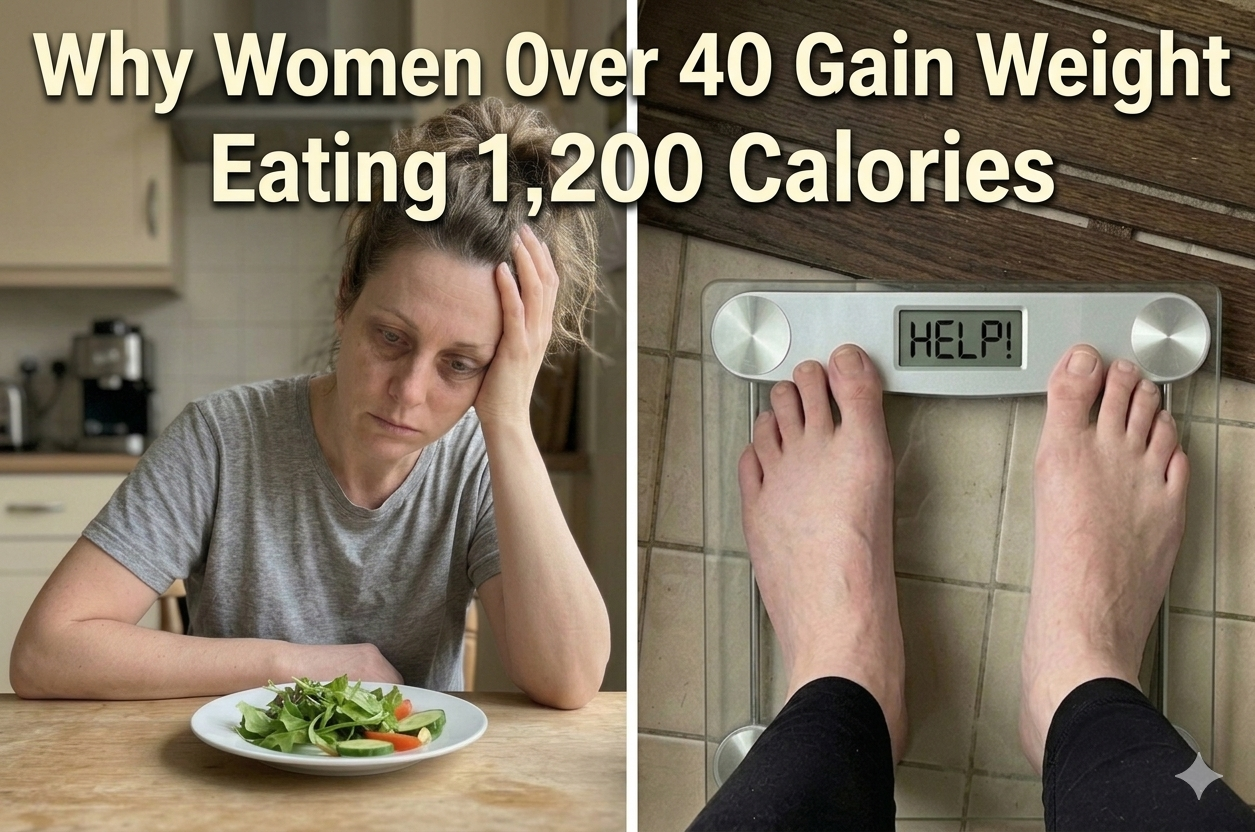
If you're a woman over 40 eating 1,200 calories a day and watching the scale go nowhere — or worse, watching it climb — you're not failing. You may be experiencing a well-documented hormonal response that the standard medical advice completely ignores.
A growing body of research from the Journal of Clinical Endocrinology & Metabolism, Harvard Medical School's menopause research group, and the Endocrine Society is converging on a finding that upends the "eat less, move more" framework: for women in perimenopause and beyond, calorie restriction doesn't just stop working. It actively promotes belly fat storage.
Here's what the data actually shows.
The 18% Cortisol Problem
When researchers measured cortisol levels in perimenopausal women on calorie-restricted diets (under 1,400 calories/day), they found something striking:
The numbers tell a story the diet industry doesn't want you to hear: your body interprets calorie restriction as famine. And its response to famine is elegant, ancient, and devastating if you're trying to lose belly fat.
Cortisol — the stress hormone — surges. And cortisol has a specific job when it thinks you're starving: store fat around your vital organs. Your belly. The one place you're trying to lose it.
The harder you diet, the more cortisol. The more cortisol, the more belly fat. You're not failing the diet. The diet is failing your biology.
And here's what makes it worse: the most common responses to a stalled scale are the exact triggers that accelerate this cascade.
Cutting calories further. Cortisol spikes higher. Your body doubles down on fat storage because the famine signal just got louder.
Adding more cardio. Cortisol stays elevated for hours without estrogen to bring it back down. The 60-minute spin class you added is feeding the same loop that's storing your belly fat.
Trying intermittent fasting. Extended fasting windows destabilize blood sugar and trigger the same cortisol response as calorie restriction. The 16:8 schedule that worked at 35 is now spiking the exact hormone that stores visceral fat.
Switching to low-fat. Dietary fat is the raw material your body uses to produce estrogen and progesterone. Cutting it accelerates the hormone decline that's driving the problem in the first place.
Every "solution" the diet industry offers a woman over 40 feeds the exact hormonal loop that's storing her belly fat. The harder you try, the harder your body fights back.
Why the Rules Change at 40
This cortisol response exists at every age. But it's manageable when you're 30 because estrogen acts as a buffer. Estrogen keeps cortisol in check, maintains insulin sensitivity, and directs fat storage away from the midsection.
After 40, that buffer disappears. And it happens faster than most women realize.
Researchers identified five distinct mechanisms that activate simultaneously in calorie-restricted women over 40:
- 1 The cortisol surge. Calorie restriction elevates cortisol by 18% on average. Without estrogen's buffering effect, cortisol triggers visceral fat storage directly — specifically around the abdomen.
- 2 The muscle cannibalization spiral. Elevated cortisol breaks down lean muscle for energy. Less muscle means a lower metabolic rate. A lower metabolic rate means fewer calories burned at rest. The diet works against itself.
- 3 The thyroid slowdown. Extended calorie restriction suppresses T3 (active thyroid hormone) production. This is your body deliberately slowing your metabolism to conserve energy. Symptoms: cold hands, brain fog, exhaustion, hair thinning.
- 4 The insulin resistance amplification. Cortisol makes cells more resistant to insulin. More insulin circulates. More insulin means more fat storage signals. The carbs you eat at 45 get stored as fat where they would have been burned as fuel at 35.
- 5 The rebound cascade. When the diet inevitably breaks (because the body is screaming for fuel), the depleted metabolic rate means weight returns faster than before — and preferentially as belly fat. Each diet cycle makes the next one harder.
These five mechanisms don't just make dieting ineffective after 40. They make it actively counterproductive. The women who gain weight eating 1,200 calories aren't doing something wrong. Their bodies are doing exactly what the science predicts.
Now imagine a different morning. You wake up at 6 AM after a full night's sleep. No 2 AM jolt. No racing heart. You eat breakfast without guilt — a real meal — and by 10 AM you're focused and energized instead of foggy and reaching for coffee.
Your belly isn't bloated. Your jeans fit the way they did three years ago. You step on the scale and the number makes sense for the first time in years.
That's not a fantasy. It's what happens when cortisol, insulin, and estrogen are working together instead of against each other. And for hundreds of women over 40, it started with one counterintuitive change.
The Counterintuitive Solution
If calorie restriction triggers this cascade, the logical question is: what happens when you eat more?
The research points to a specific approach — not just eating more food, but eating the right foods at the right times to work with the hormonal rhythms that change after 40.
Cortisol follows a daily curve. It peaks in the morning and should taper through the day. When you skip breakfast or eat too little in the morning, you extend the cortisol peak. When you eat a protein-rich meal within an hour of waking, you signal safety and the cortisol curve normalizes.
Insulin sensitivity changes throughout the day. Your cells are most responsive to insulin in the morning and least responsive at night. A large dinner sends glucose into a system that's already winding down — and stores it as fat. The same meal at lunch would be metabolized cleanly.
Estrogen clearance depends on your gut and liver. When excess estrogen can't be processed efficiently, it recirculates — driving more fat storage in the hips, thighs, and belly. Specific foods accelerate estrogen clearance. Most women aren't eating them.
Health researcher Jenny Cheryl spent two years reviewing 73 peer-reviewed studies on these mechanisms after experiencing the exact same pattern herself — eating 1,200 calories, exercising five days a week, and gaining weight at 44.
"I stopped restricting calories and started timing my meals to my cortisol and insulin curves. I went from 1,200 to 1,600 calories a day. I lost 14 pounds in 8 weeks. My doctor asked me what I changed."
She compiled the complete framework — the hormone science, the meal timing protocols, and the specific adjustments for cortisol-dominant, estrogen-dominant, and insulin-resistant patterns — into a book called Eat More, Lose More.
What Other Women Are Reporting
Since the book's release, hundreds of women over 40 have applied the framework. The results follow a consistent pattern:
"I've read a dozen diet books. This is the first one that explained the WHY. Once I understood the cortisol trap, I stopped doing the exact things that were making me fatter."
Rachel, 47, was eating 1,100 calories and exercising six days a week. After switching to the book's hormone-timed approach — eating more food, exercising less — she lost 8.4 pounds in 14 days.
Karen, 43, dropped 9 pounds and 2.8 inches by cutting her spin classes from five to two per week and adding short resistance sessions. She told the author: "I can't believe I spent two years punishing my body when the answer was being kinder to it."
Diane, 51, was eating 1,200 calories and gaining weight. She increased to 1,600 calories using hormone-timed meals and lost 5.8 pounds in 21 days.
"The gut-hormone chapter alone was worth 10x the price. I made one change from page 94 and my bloating disappeared in four days."
The complete hormone timing framework that helped these women stop dieting and start losing. 7 chapters covering cortisol, estrogen, insulin, meal timing, sleep, and exercise. Instant PDF download.
Get the Hormone Timing Framework — $7 Instant download · 30-day money-back guarantee4.9 stars · 200+ women downloaded this week
What the Book Covers
The framework is broken into seven chapters, each addressing a specific piece of the hormonal puzzle:
Chapter 1: The Metabolic Lie — the data behind why "eat less, move more" reverses after 40, and the specific age range when the shift happens.
Chapter 2: The Cortisol Trap — how calorie restriction and intense exercise spike the hormone that stores belly fat, and a 20-minute alternative that does the opposite.
Chapter 3: The Estrogen Drop — the hormone ratio that controls where your body stores fat, and why it redirects to your midsection years before menopause.
Chapter 4: Eat More, Lose More — the complete meal timing protocol built around your daily cortisol and insulin rhythms.
Chapter 5: The Sleep-Weight Connection — the 90-minute pre-bed window that determines whether you burn fat or store it overnight.
Chapter 6: Move Smarter, Not Harder — why women who exercise less after 40 often lose more, and the 10-minute movement sequence that triggers growth hormone without spiking cortisol.
Chapter 7: The Gut-Hormone Axis — the connection that determines whether excess estrogen leaves your body or recirculates, and the grocery store item that fixes it.
The complete hormone science and meal timing framework in 7 chapters. Written by a health researcher who experienced — and reversed — the exact pattern described in this article. Instant PDF download.
Get the Hormone Timing Framework — $7 Instant download · 30-day money-back guarantee4.9 stars · 200+ women downloaded this week
The Bottom Line
The research is increasingly clear: the 1,200-calorie advice that doctors have given women for decades doesn't account for the hormonal reality of perimenopause and menopause. For many women over 40, it doesn't just fail — it makes the problem measurably worse.
The solution isn't another diet. It's understanding why your body changed the rules — and learning the framework that works with those new rules instead of against them.
The book is $7. It comes with a 30-day money-back guarantee. And based on the research reviewed for this article, it may be the most useful $7 a woman over 40 can spend on understanding what's actually happening in her body.
Stop fighting your hormones. Start working with them. The framework covers cortisol, estrogen, insulin, meal timing, sleep, and the exact exercise approach that works after 40.
Get the Hormone Timing Framework — $7 Instant download · 30-day money-back guarantee4.9 stars · 200+ women downloaded this week